Guide · Cooking for guests
Cooking for a crowd: easy meals for large groups, without the panic.
Your recipes are written for four and twelve people are coming. Which dishes survive being doubled, what not to multiply, and how to get two days of cooking onto one shopping list.
Short answer
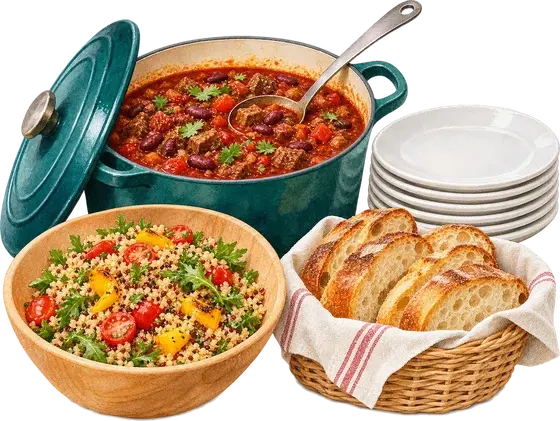
Easy meals for large groups are the ones that wait well: a braise, a tray bake, a big pasta bake, a pot of chili, a grain salad. Cook two or three of those instead of one fancy dish, scale each recipe to the real head count, keep salt and spices a little under the multiplied amount, and do as much as you can the day before. Write everything on one shopping list, so a forgotten lemon does not send you back to the shop while the guests ring the bell.
Why cooking for twelve goes wrong
The recipe was fine for four. Times three, the onions steam instead of browning because they are piled in one pan, the oven is full of three trays that need three different temperatures, and the stew tastes oddly salty. None of that is your fault. Home recipes are written for a family-sized pot, and they do not tell you what happens when you push them past it.
The other half of the stress is logistics. Four recipes, saved in four places, each listing its own garlic and its own lemons. You add it up on the back of an envelope, miss the cream, and find out at five o'clock. Most of what follows is about getting the planning out of your head and onto paper (or a phone) early, so the cooking day is only cooking.
Pick dishes that are happy to wait
For a crowd, the best dish is one that tastes the same at 7:40 as it did at 7:00. Braised meat, ragù, curry, chili and soup get better overnight. Lasagne and baked pasta can be assembled the day before and baked when people arrive. A roast tray of chicken thighs with potatoes feeds eight from one oven shelf. Grain salads, such as farro or couscous with roasted vegetables, sit at room temperature for an hour without sulking.
Avoid anything that needs you at the stove at the last minute: risotto for twelve, steaks cooked to order, deep-fried anything. Also be careful with recipes that already sit at the edge of your largest pot. Doubling a stew that fills your casserole dish means two pots, and two pots means twice the stirring.
Collect the candidates in one place before you decide. In FOODIE, make a cookbook for the occasion, for example "Saturday dinner, 12 people", and use Add to Book on each recipe you are considering, whether you saved it from a food blog, a Reel or a photo of a page in an old cookbook. One recipe can sit in several books, so your everyday lasagne can join this one too. When the book is in front of you, the choice gets easier: one main that waits, one side that is fine at room temperature, one thing made the day before.
- One main that can be held warm, such as a braise, chili, a tray bake or a big baked pasta.
- One or two sides that do not need the oven at the same time as the main.
- One thing prepared completely the day before: dessert, a salad dressing, a sauce.
- Bread or a simple grain to fill people up if you underestimated portions.
Scaling a recipe from 4 to 12 servings
The arithmetic is simple: divide the number of guests by the servings in the recipe and multiply every ingredient by that. A recipe for 4 cooked for 12 is times three. The recipe scaler on this site does every line at once if you paste the ingredients.
The amounts are the easy part. What does not scale in a straight line is the rest. Salt, chili, strong spices and baking soda can taste too much at triple quantity, so put in about three quarters of the scaled amount and taste at the end. Liquid in a braise evaporates from the surface of the pot, not from the volume, so a pot three times as full needs less than three times the stock. Browning meat for twelve takes three batches, not one crowded pan, or it will boil in its own juices. And a deeper tray takes longer in the oven: check a lasagne that is twice as thick 15 or 20 minutes later than the recipe says, with a knife in the middle.
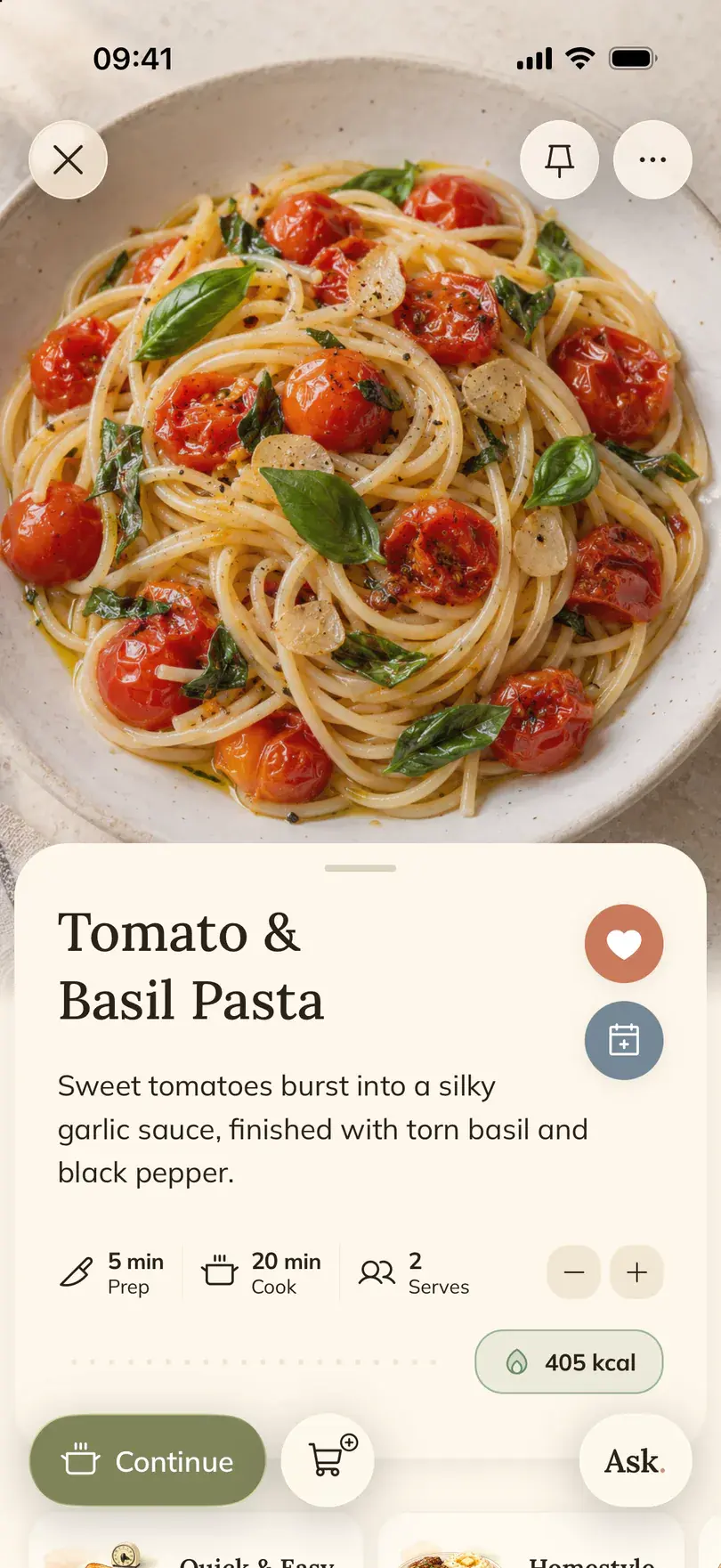
In FOODIE, open the recipe and change the servings with plus and minus. Every ingredient amount is recalculated, and the steps show the new quantities too, so the step that says "add 400 g tomatoes" now says the tripled amount. The app goes up to 20 servings per recipe; for a bigger party, cook the recipe twice or split it between two dishes. The scaled servings follow you into the shopping list and into cooking mode (more on both below), and the details are on the servings section of cooking mode.
What to do with each ingredient when you triple a recipe
| Ingredient | Scale it | Watch out for |
|---|---|---|
| Meat, vegetables, pasta, rice | Fully, times three | Brown or roast in batches, not one crowded pan |
| Salt, chili, strong spices | About three quarters, then taste | Flavour builds faster than you expect in a big pot |
| Stock and liquid in braises | A bit less than times three | Less evaporates from a full pot; add more later if needed |
| Baking powder and soda in cakes | Bake two cakes rather than one triple cake | A giant cake sinks in the middle or dries out at the edges |
| Oven time | Not by the multiplier | Thicker trays take longer; check the centre, not the clock |
Spread the cooking over two days
The calmest hosts do most of the work the day before. Braises, ragù, chili, soups, dressings, dessert and any marinade can be finished a day ahead and put in the fridge. On the day you only reheat, bake what was assembled, and make the one thing that has to be fresh, often just a green salad and warm bread. The same make-ahead logic, applied to an ordinary week, is batch cooking for the week.
Write the plan down by day, not by recipe. Friday evening: chili, dressing, dessert. Saturday afternoon: assemble and bake the pasta, roast the vegetables, toss the salad at the last minute. When it is written like that, you see right away if three dishes need the oven at once.
FOODIE's planner works for this. From each recipe, choose Schedule Meal and put it on the day you will actually cook it: the chili on Friday dinner, the pasta bake and salad on Saturday. The week view then shows your two cooking days at a glance. The planner does not set timers or tell you oven temperatures; it is your list of what gets cooked when. More on how it works in the meal planner, and the same day-by-day habit is the core of planning a weekly menu.
One shopping list for four recipes
This is where a party usually breaks. Four recipes each want garlic, onions and lemons, in different amounts, and you need the total. Add up each ingredient across every recipe before you leave home, then check the fridge and cross off what you already have. Shopping once, a day or two before, also keeps you from buying fresh herbs on the morning of the party and finding the shop out of them.
In FOODIE, first set each recipe to the right servings, then tap the basket button on the recipe page. All its ingredients go into Groceries with the scaled amounts. Do the same for every dish. In Groceries, the Ingredients view puts the same ingredient from different recipes together and shows the total, so you see 9 cloves of garlic once, not three times. Recipes groups the list by dish if you want to check that nothing is missing, and Aisles sorts it by part of the shop. Remaining hides what you have already ticked off. If someone else is doing the shopping, Share shopping list sends it as text. The grocery list page has the details.
One honest limit: Groceries only holds ingredients that come from recipes. You cannot type in extra items like napkins or ice, so keep those on a separate note.
On the day: one step at a time
With guests talking in the kitchen, you lose your place in a recipe easily. Work from a recipe that shows one step at a time, with the amounts for that step written in, so you are not doing maths on a tripled recipe while someone asks where the glasses are.
In FOODIE, tap Cook on the recipe. Cooking mode shows one step per screen with the ingredients it needs, at the servings you set, and keeps the screen awake while your hands are messy. If you have to stop and come back, the recipe picks up from the same step. When a question comes up mid-cook, such as how long to bake a lasagne that is twice as thick or what to use instead of crème fraîche because the shop ran out, tap Ask: the AI Chef answers about that recipe without you leaving the step. More on that in the AI cooking assistant.
Good to know
What no app can do for you here
- Taste. Scaled seasoning is a starting point; the pot decides the rest.
- Oven space. If three dishes need 200 °C at the same time, plan one to be made ahead or cooked on the hob.
- Bigger pots. Scaling the amounts does not make your casserole dish bigger; cook in two.
- FOODIE scales a recipe up to 20 servings. For more, cook it twice.
- FOODIE runs on iPhone and iPad. There is no Android app yet.
How to do this in FOODIE: Digital Recipe Book
Gather the dishes you are considering into one cookbook with Add to Book. On each recipe, set the servings to your head count, tap the basket button to send the scaled ingredients to Groceries, and use Schedule Meal to put it on the day you will cook it. Shop from the Ingredients view, where the totals are already added up. On the day, open each recipe with Cook and ask the AI Chef with Ask when something does not go to plan. For the cookbook itself, see the digital recipe book; if the guests are a regular weeknight family instead of a party, start with what to cook for dinner.
Common questions
Frequently asked.
5 answers to the things people ask us most. Tap any question to expand.
What are easy meals for large groups?
Dishes that can wait without losing anything: chili, curry, braised meat, ragù with pasta, lasagne or another baked pasta, a tray of roast chicken thighs and potatoes, and grain salads served at room temperature. Avoid dishes that need you at the stove at the last minute.
How do I scale a recipe for a crowd?
Divide the number of guests by the recipe's servings and multiply each ingredient. Then adjust: about three quarters of the scaled salt and spices, a little less liquid in braises, browning in batches, and longer oven time for thicker trays. In FOODIE, changing the servings recalculates every amount, including the ones in the steps.
How much food do I need per person?
As a rough guide for a main course, cooks often plan about 150 to 200 g of meat or fish per adult, and about 100 g of dry pasta or rice. With two or three dishes on the table, people take less of each, so you can stay at the lower end and add bread.
Can FOODIE add up the same ingredient across several recipes?
Yes. Add each recipe to Groceries at the servings you need, and the Ingredients view groups the same ingredient from different recipes and shows the total amount.
Can I scale a recipe to more than 20 servings in FOODIE?
No, the servings go up to 20 per recipe. For a larger group, cook it in two batches, or pick a second dish so each recipe stays at 20 or fewer.
Bottom line
Cooking for a crowd goes well when the dishes can wait, the amounts are scaled with a little care for salt and liquid, and most of the work is done the day before. Get the recipes into one place, the ingredients onto one list and the cooking onto two days, and the party is mostly reheating and talking.
FOODIE: Digital Recipe Book
Plan your next big dinner in FOODIE.
Collect the recipes in one cookbook, scale them to your guests and shop from one list on iPhone or iPad.
 Try Foodie for free
 Scan with iPhone to download