Guide · Meal planning
Batch cooking in two hours, with food you still want to eat on Thursday.
Too tired to cook every evening, but a whole Sunday at the stove is too much? Here is how to run one short session: what to cook, in what order, what keeps and what goes in the freezer.
Short answer
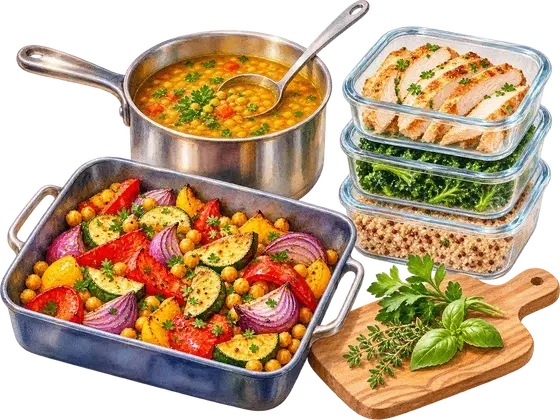
Batch cooking works best as one session of about two hours for three or four recipes, not a day of cooking. Cook components (a grain, a tray of roast vegetables, a protein, one sauce) rather than seven identical boxes. Turn the oven on first, run the hob alongside it, and do the cold prep while both cook. Eat what is in the fridge within 3 to 4 days and freeze anything meant for Thursday onwards. That is how to meal prep without the food spoiling or getting boring by midweek.
Why most meal prep fails by Thursday
The usual plan goes like this: a Sunday afternoon at the stove, ten matching containers, and on Wednesday the same chicken and rice for the third time. By Thursday half of it smells doubtful and goes in the bin, and next Sunday nobody wants to do it again.
Three things cause most of that. The session tries to cook too many dishes, so it eats the whole day. Everything goes into the fridge, although cooked food keeps only 3 to 4 days there. And every box is finished in advance, so nothing can change once you are tired of it. A shorter session, a freezer for the second half of the week and food that is only partly assembled fix all three.
Five honest ways to batch cook
There is no single right method. Pick the one that matches how many evenings you need to cover and how much sameness you can stand. Meal prep for beginners is easiest with the last two: you change one habit, not your whole weekend.
- Full meals in containers. Every lunch or dinner is portioned and ready. Best for workday lunches and people who truly do not mind repeats. Worst for variety, and salads and crispy things suffer in the box.
- Component prep. A grain, roast vegetables, a protein and a sauce, each in its own container, put together each evening in a few minutes. More flexible, a little more work on the night.
- Cook once, eat twice. A big pot of chili or a roast chicken becomes two different dinners in the same week. Almost no extra effort, but it covers two nights, not five.
- Freezer batches. A double pot of soup, stew or sauce, frozen in portions for the weeks ahead. Saves the most time over a month, and it needs freezer space and a little planning to thaw.
- Double tonight's dinner. Cook twice the amount on a calm evening and put half away. No session at all, which is why it is the easiest habit to keep.
Pick three or four recipes, and put them in one book
Four recipes is about what two hours and one oven can handle. A good set has different jobs: one thing for the oven (roast vegetables, chicken thighs, a tray bake), one pot on the hob (chili, curry, a tomato sauce, lentils), one plain base (rice, quinoa, potatoes) and one cold thing (a dressing, a slaw, boiled eggs). Two oven dishes that need different temperatures, or three pots fighting for two burners, are what turn two hours into four.
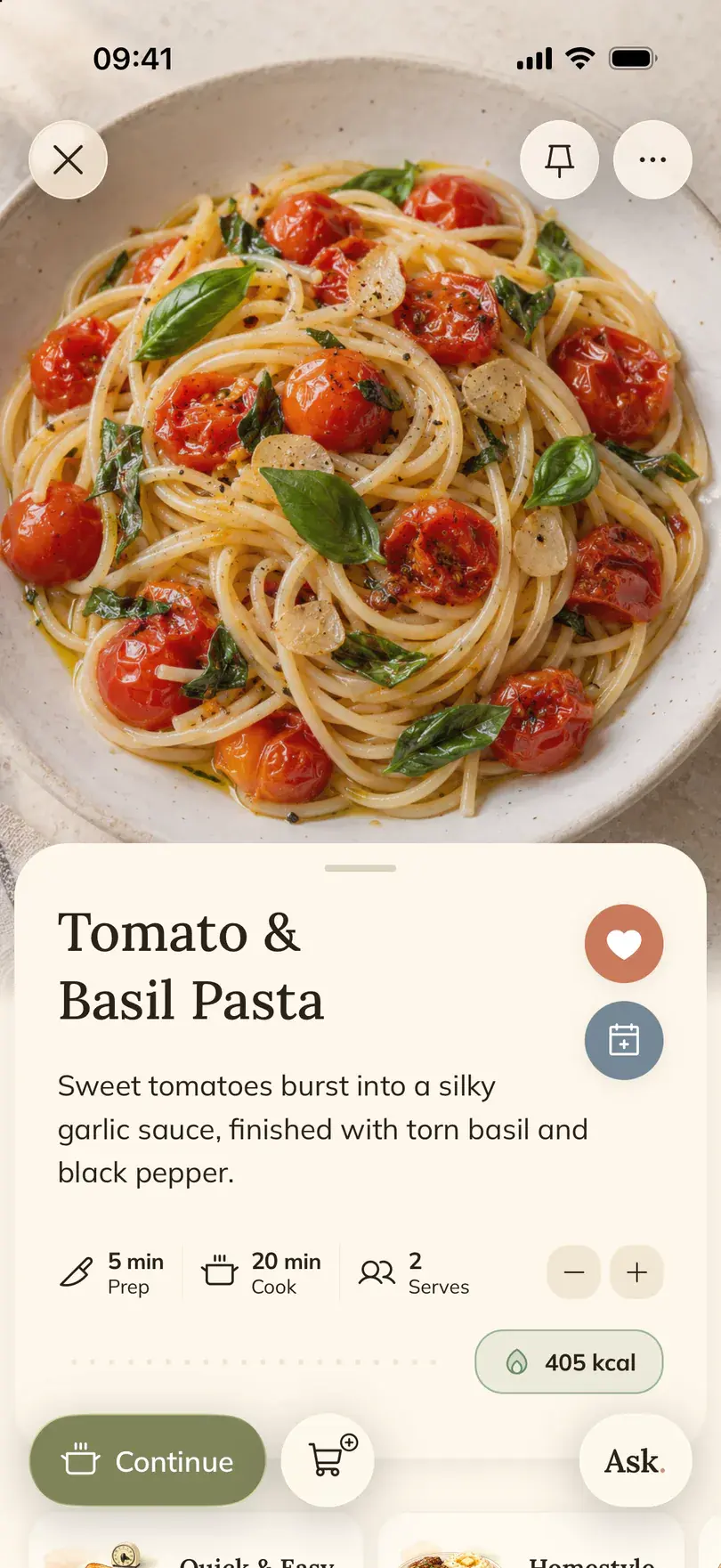
Choose dishes you already cook. A session with a new recipe in it takes longer, because you keep stopping to read. If your recipes live in FOODIE, open each one and tap Add to Book to put the week's set into one book, for example one called Batch day. Then everything you need for the session is in one place, and next month you can reuse the set or swap one dish. If your recipes are still scattered across screenshots and bookmarks, a digital recipe book is the first step.
Scale each recipe to the week, then shop once
A recipe for four makes two dinners for two, or four lunches for one. Work out how many portions of each dish you actually want before you shop, and remember the freezer can take some of them.
In FOODIE, change the servings on the recipe page with the plus and minus buttons, up to 20. The ingredient amounts follow, and so do the amounts shown in the steps, so you are not doubling numbers in your head halfway through. For a recipe on paper, the recipe scaler does the maths.
Then put the dishes on days. Use Schedule Meal on each recipe to place it on the day you plan to eat it, as breakfast, lunch, dinner or a snack, and check the Week view of the meal planner to see which evenings are covered and which are freezer nights. If you have not decided which dinners go into the week yet, planning a weekly menu in 15 minutes covers that part.
For the shopping, tap the cart on each recipe after setting the servings, so the scaled amounts go to Groceries. With three or four recipes, onions, garlic and rice come up more than once. Groceries shows the list three ways: Ingredients, Recipes and Aisles. In Ingredients, the same ingredient from different recipes is added up when the units match, so you see one line for onions, not four. Aisles groups the list by section of the shop, and Share shopping list sends it to whoever is going to the shop (how the grocery list works).
How to meal prep in about two hours: the order of work
The whole trick is running three things at once. The oven does the slow work without you, the hob needs a stir now and then, and the counter is where your hands are. If you cook one dish after another, the same food takes twice as long.
Before you start, empty the dishwasher and clear a shelf in the fridge. You will need both. Then work roughly in this order:
- Oven first. Turn it on to about 220°C (200°C fan, 425°F) before anything else, and get the trays in within ten minutes: chopped vegetables tossed in oil and salt, chicken thighs, a tray of potatoes. Roasting is the longest step, so it starts first.
- Hob next. Put the slowest pot on while the oven heats: dried lentils, a chili, a tomato sauce. Then the grain: rice or quinoa is mostly waiting, so it fits in between.
- Cold prep while things cook. Wash and dry salad leaves, chop raw vegetables for snacks, make a dressing, boil a few eggs. This is the work that does not need heat, and it fills the time you would otherwise spend watching pots.
- Check, turn, take out. Stir the trays halfway. Cook chicken until the thickest part reaches 74°C (165°F); a cheap probe thermometer ends the guessing.
- Cool and pack. Spread rice and grains out on a tray, divide stews into shallow containers and get everything into the fridge or freezer within two hours of cooking.
- Wash as you go. A pot soaks while the next thing cooks, so the session ends with a clean kitchen instead of a second job.
A sample two-hour batch cooking session for four recipes
| Time | Oven | Hob | Counter |
|---|---|---|---|
| 0:00 to 0:15 | Heat to 220°C (425°F); trays of vegetables and chicken thighs go in | Onion and garlic for the chili start in a big pot | Chop the vegetables, season the chicken |
| 0:15 to 0:45 | Roasting | Chili simmers; pot of rice goes on | Wash salad leaves, make a dressing, put eggs on to boil |
| 0:45 to 1:15 | Turn the trays; check chicken reaches 74°C (165°F) | Rice done and spread on a tray to cool; chili keeps simmering | Peel eggs, chop raw vegetables for snacks |
| 1:15 to 1:45 | Trays out to cool | Chili done; take it off the heat | Portion the chili into shallow containers; label the freezer ones |
| 1:45 to 2:00 | Off | Off | Fridge, freezer, last pots in the sink |
Cook in cooking mode, one recipe at a time
A batch session means four recipes open at once and greasy hands. In FOODIE, tap Cook on the recipe page to start cooking mode (how cooking mode works). Each step fills the screen, one at a time, with the scaled amounts you chose, and the screen stays on, so you are not unlocking the phone with a floury thumb.
Cooking mode follows one recipe at a time, and it remembers only the last recipe you started. Use it for the dish with the most steps, such as the chili, and make short things like the dressing straight from the recipe page. If you start another recipe in cooking mode, the chili's Cook button no longer turns into Continue, so note which step you were on. There are no timers in cooking mode, so use the oven timer or your phone's clock for the trays.
What keeps in the fridge, what to freeze, what goes soggy
Cooked food keeps 3 to 4 days in a fridge at 4°C (40°F) or below. So food cooked on Sunday covers Monday to Wednesday. Anything for Thursday or Friday goes into the freezer on the day you cook it, and comes out to thaw in the fridge the night before.
Cooked rice needs extra care, because the spores of a bacterium that survive cooking can grow while it sits warm. Cool it fast, refrigerate it within an hour if you can, eat it within a day or two and reheat it only once. If that is too tight for your week, freeze it in portions.
These freeze well, and the rest is better eaten fresh:
- Freeze well: soups, stews, chili, curries, tomato and meat sauces, cooked beans and lentils, cooked rice and grains, meatballs, burritos, muffins and bread.
- Freeze badly: boiled or cubed potatoes (grainy), pasta already in sauce or soup (mushy), cream and yogurt sauces (can split), salad leaves, cucumber, hard-boiled eggs (rubbery whites), anything fried or crispy.
- Go soggy in the fridge: dressed salads, crispy toppings, toast and crackers, cut avocado and apple. Keep dressings, crunchy bits and soft fruit separate and add them on the day.
- Keep well for a few days raw: washed and dried leaves in a box with a paper towel, chopped carrots, peppers and celery, a jar of dressing.
Cool fast, store safely, reheat properly
Food left to cool slowly on the stove is the main safety risk in batch cooking. Bacteria grow fastest between about 4°C and 60°C (40°F and 140°F), and a deep pot of chili stays in that range for hours. Divide it into shallow containers, spread rice on a tray, and get everything cold within two hours of cooking (one hour on a very hot day). Putting warm food in the fridge is fine; leaving it on the counter to cool overnight is not.
Label containers with the dish and the date, and put the oldest at the front. When you reheat, heat it until it is steaming hot all the way through, 74°C (165°F) in the centre, and stir in the microwave so there are no cold spots. Reheat only the portion you will eat, not the whole container again and again. If something smells off or you have lost track of the date, throw it out; it is not worth guessing.
Unsure whether a particular dish freezes or how long it keeps? In cooking mode, tap Ask: the AI Chef opens with the recipe you are cooking, and one of the suggested questions is Store leftovers. Ask "does this freeze?" or "how long does this keep in the fridge?" about that exact dish. For anything to do with food safety, take its answer as a starting point, not the last word.
One base, three finishes: keeping it from getting boring
Variety comes from the last five minutes, not from cooking more dishes. Prepare a base plainly, with only salt, and finish it differently each night. The same tray of roast vegetables and pot of rice turn into:
- Monday: a rice bowl with the vegetables, a fried egg and soy sauce with chilli.
- Tuesday: the vegetables blitzed with stock into soup, with toast.
- Wednesday: the vegetables and a portion of rice from the freezer in a tortilla with cheese, black beans and salsa.
- From the freezer later in the week: chili with a portion of frozen rice and a spoon of yogurt.
- Keep a few finishes that take no prep: a jar of pesto, yogurt with garlic, kimchi, pickled onions, toasted seeds, a lemon.
Save your batch version of the recipe
After a session or two, your batch version of a recipe will differ from the original: double the amount, no cream so it freezes, spices adjusted so it tastes good after reheating. Keep that version instead of remembering it.
Open the recipe and tap Ask on the recipe page. Ask the AI Chef for the change you want, for example "make this freezer-friendly for 8 portions". It shows what it changed, and Save as new keeps your batch version next to the original, while Update this recipe replaces it. This works from Ask on the recipe page; the chat you open from cooking mode answers questions but cannot save a recipe. Feeding a full table instead of a week of evenings? Cooking for a crowd covers scaling for one big meal.
Good to know
What to keep in mind
- Fridge times are a safe limit, not a target. Cooked food is best within 3 to 4 days at 4°C (40°F) or below; freeze the rest on the day you cook it.
- Rice, chicken and anything with cream or eggs deserve the most care. When in doubt about a dish's age, throw it out.
- Food safety rules differ slightly by country. Follow your local food safety agency where its advice is stricter than this guide.
- The AI Chef cannot see or smell your food. Use its answers about storage as a guide and your own judgement and labels as the final check.
- Cooking mode shows one recipe at a time and has no timers. Switch recipes by opening the next one, and use the oven or phone timer.
- The free plan includes 10 recipes. FOODIE runs on iPhone and iPad; there is no Android version.
Common questions
Frequently asked.
6 answers to the things people ask us most. Tap any question to expand.
How do I start batch cooking if I have never done it?
Start small: double one dinner this week and freeze half, or cook one grain and one tray of roast vegetables on Sunday. Once that becomes a habit, add a pot of soup or sauce and you have a full two-hour session.
How long does batch-cooked food keep in the fridge?
Cooked food keeps 3 to 4 days in a fridge at 4°C (40°F) or below. Cooked rice is best eaten within a day or two. Freeze anything you plan to eat later in the week on the day you cook it.
What should I not freeze?
Boiled potatoes, pasta already mixed with sauce, cream or yogurt sauces, salad leaves, cucumber, hard-boiled eggs and fried or crispy food. Soups, stews, chili, curries, tomato sauces, beans and cooked grains freeze well.
How do I reheat meal prep safely?
Reheat only the portion you will eat, until it is steaming hot all the way through, 74°C (165°F) in the centre. Stir halfway in the microwave so there are no cold spots, and reheat rice only once.
Can FOODIE make one shopping list for all my batch recipes?
Yes. Set the servings on each recipe, then tap the cart to send its ingredients to Groceries. The same ingredient from different recipes is added up when the units match, and the Aisles view groups the list by section of the shop.
Can I follow several recipes at once in FOODIE's cooking mode?
Cooking mode follows one recipe at a time. If you leave it, the Cook button on that recipe turns into Continue and opens the step you stopped on, but only for the last recipe you started. Use cooking mode for the longest recipe and make the short ones from the recipe page.
Bottom line
Two hours, three or four recipes you already know, the oven and hob working at once, and a freezer for the second half of the week. Cook components, finish them differently each night, cool everything fast and eat the fridge food within 3 to 4 days.
FOODIE: Digital Recipe Book
Run your batch day from your own recipes.
Put the week's recipes in one book, scale them, plan the days and shop from one list in FOODIE, then cook step by step in cooking mode.
 Try Foodie for free
 Scan with iPhone to download