Guide · Cooking skills
How to get better at cooking, one question at a time.
You can follow a recipe. The next step is knowing why it works, and having someone to ask when the sauce will not thicken.
Short answer
To get better at cooking, cook fewer new recipes and repeat a few dishes, changing one thing each time. Learn the handful of techniques that recipes assume you know: heat control, seasoning as you go, browning, reducing a sauce. And get your questions answered while the pan is still on the heat, by a person, a video or an AI assistant, so you learn why each step is there.
Why following recipes does not make you a better cook
A recipe tells you what to do and almost never why. It says "cook until thickened" without saying what to do when it does not thicken. It says "fold in the egg whites" as if everyone knows what folding looks like. So you guess, the dish turns out fine or not, and you have no idea which part made the difference.
The questions come at the worst moment: hands covered in flour, onions already in the pan, nobody around. Can I use yogurt instead of sour cream? Is this chicken done? Why is my dough so sticky? If nobody answers, you either stop and search with greasy fingers or push on and hope. Either way, you learn little.
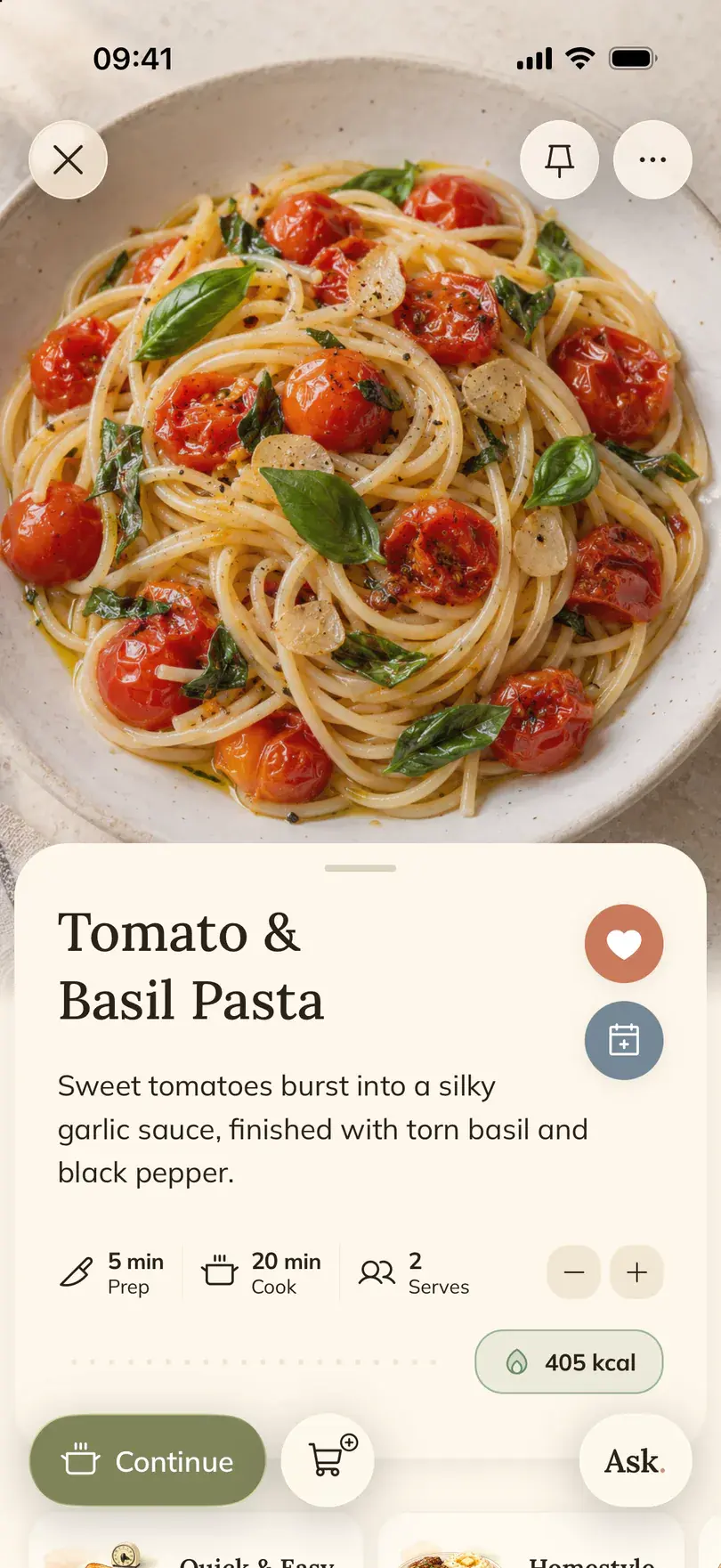
Getting better comes from two habits: working on a small set of recipes until you understand them, and getting answers at the moment the question appears. Start by choosing the recipes. Pick five or six dishes you actually want to master and keep them in one place, not scattered across bookmarks, screenshots and a cookbook with a broken spine. In FOODIE you add each one with Paste link for a website or a TikTok, Instagram or YouTube video, Photo for a page from a cookbook, or Text for a recipe you type in your own words. More on that in how saving recipes works.
Cook the same dish until you own it
Repetition teaches more than variety. The third time you make the same risotto, you stop reading the recipe and start watching the rice. That is when you notice how the starch makes the liquid creamy, how much stock it really takes, and what "al dente" feels like between your teeth.
Change one thing per round, so you know what caused the result. Good dishes to practise on, and what to vary:
- Roast chicken: salt it the night before once, and once just before roasting. Compare the skin and how seasoned the meat is inside.
- A pan sauce after searing meat: try it with wine, then with stock, then add a spoon of cold butter at the end and see how it turns glossy.
- Vinaigrette: start with three parts oil to one part vinegar, then taste and move towards what you like. Add mustard to see how it holds the dressing together.
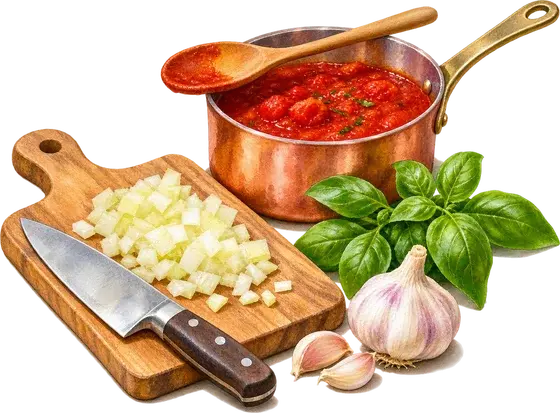
- Tomato sauce: simmer it twenty minutes, then forty. Notice how it gets sweeter and thicker.
- Scrambled eggs: cook them on high heat once and on low heat once. The difference teaches heat control better than any explanation.
Write down what you changed, next to the recipe
A change you do not write down is a change you will forget by next month. Keep the note where you will see it next time you cook the dish, not in a separate notebook.
In FOODIE, open the recipe, tap Edit and go to the Tips tab. Each tip is its own line ("Write a tip…"), so you can add "salted overnight: better skin" or "needs 1 cup more stock than written". The tips show on the recipe page every time you open it. If you cook a dish for a different number of people, change the servings on the recipe page before you start; the amounts in the steps change too. For a recipe on paper, the free recipe scaler does the same maths. Keeping the dishes you are working on together also helps: put them in one book, as described in the digital recipe book.
Learn the techniques recipes assume you know
Most recipes are written for someone who already knows the basics. A few techniques come up in almost every dinner, and learning them on purpose pays off faster than any new recipe:
- Heat the pan before the oil, and the oil before the food. Food added to a cold pan sticks and steams instead of browning.
- Do not crowd the pan. Leave space between pieces of meat or mushrooms, or they release water and boil. Cook in two batches if needed.
- Season in layers and taste as you go. A pinch of salt on the onions, more in the sauce, a final check at the end. Tasting only at the end is how dishes end up flat.
- Add acid when something tastes dull. A squeeze of lemon or a splash of vinegar often fixes what more salt cannot.
- Reduce to thicken. A sauce gets thicker when water evaporates, so simmer it uncovered. If you are short on time, a teaspoon of cornstarch mixed with cold water thickens it in a minute.
- Check doneness with a thermometer, not the clock. Ovens and pans vary; chicken is safe at 165°F inside, whatever the recipe's timing says.
- Let meat rest after cooking. Five to ten minutes on a board keeps the juices in the meat instead of on the plate.
- Learn to dice an onion properly. It is in half of all recipes, and a steady technique makes every dinner faster.
How to get better at cooking: the honest options
| Way | Best for | Downside |
|---|---|---|
| Cook one dish several times | Understanding cause and effect in your own kitchen | Slow at first, and you eat the same thing for a while |
| Learn base techniques | Making every recipe easier, not just one | Practising a skill can feel less fun than cooking a new dish |
| Watch videos | Seeing what folding, soft peaks or a simmer actually look like | Hard to pause and rewind with wet hands; nobody answers your specific problem |
| Take a cooking class | Hands-on feedback on knife skills and technique | Costs time and money, and the teacher is not there next Tuesday |
| Ask someone who cooks | Family dishes and tricks that are not written anywhere | They are not always free when your sauce splits |
| Ask an AI assistant while you cook | Quick answers about swaps, fixes and terms, at the moment you need them | Can be wrong; it cannot see or taste your food |
Videos and classes: good for seeing, hard to use mid-cook
Some things are easier to learn by watching. What a dough looks like when it is kneaded enough, how a sauce coats the back of a spoon, how fast a knife moves through an onion. A short video beats a paragraph of text for all of these. Watch it before you cook, not during.
During cooking, a video gets in the way. You scrub back and forth to find the one moment you need, and the speaker moves on at their pace, not yours. If a video recipe is the one you want to practise, save it to FOODIE with Paste link: the app turns the video into a written recipe with ingredients and steps, so you can cook from text and keep the video for reference.
A class gives you what neither videos nor apps can: someone watching your hands and correcting your grip. One knife skills class is worth it if you cook often. After that, the learning happens at home, at the stove, where the questions actually come up.
Ask your question at the stove, not after dinner
The best time to learn why something works is the moment it is not working. Call someone who cooks if you can. When nobody is around, an AI assistant fills that gap, as long as you give it enough detail.
In FOODIE, tap Cook on the recipe page to open cooking mode. Each step fills the screen in large text, you tap anywhere for the next one, and the screen stays on while you cook, so you do not unlock the phone with buttery fingers. The Ingredients button shows the list with the amounts for your servings. If you leave to deal with something else, the home screen offers "Continue where you left off" and brings you back to the same step. See how cooking mode works.
When a question comes up, tap Ask. The AI Chef opens with the recipe you are cooking, so you do not have to explain the dish. It does not know which step you are on, so mention it. Questions that get useful answers:
- "I'm on step 4 and the sauce isn't thickening after 10 minutes. What do I do?"
- "I don't have sour cream. Can I use Greek yogurt, and will it split if it boils?"
- "What does fold mean here, and how do I know when to stop?"
- "The onions are browning too fast. Should I lower the heat or add water?"
- "Why does this recipe add the garlic after the onions?"
Keep the improved version of the recipe
After a few rounds you will have changes worth keeping: less sugar, a different cheese, double the garlic, a shorter bake. Rewriting the recipe by hand is where most people give up.
In the FOODIE chat you can ask the AI Chef to change a saved recipe, for example "make this with half the butter and add lemon". It shows the changes, and you choose Update this recipe to replace it, or Save as new to keep the original and add your version next to it. Save as new is the safer choice while you experiment: you can always go back. The chat can also explain techniques or suggest what to cook from the ingredients you describe; more on the AI cooking assistant.
Some recipes give amounts in grams and some in cups. When you are testing a change and need to convert, the cooking measurement converter saves the guesswork.
A month to learn to cook better, without a course
If you want structure, give yourself four weeks and one focus per week. Keep cooking your usual dinners in between; for ideas on busy nights, see what to cook for dinner.
- Week 1, heat and browning: sear chicken thighs or mushrooms twice, once in a crowded pan and once in batches.
- Week 2, seasoning: make one soup or sauce and taste it at every step. Fix it with salt, then with acid, and note what each did.
- Week 3, sauces: make a pan sauce and a tomato sauce. Practise reducing and finishing with butter or olive oil.
- Week 4, your dish: pick one recipe from the month and cook it again with everything you noted. Save the result as your own version.
Good to know
What to keep in mind
- An AI assistant can be confidently wrong. For food safety, such as chicken doneness or how long leftovers keep, trust a thermometer and official guidance over any chat answer.
- Nothing replaces tasting. The best advice still needs you to taste the sauce and decide.
- FOODIE's cooking mode has no built-in timers; use your oven or phone timer alongside it.
- Ask in cooking mode knows the recipe, not the step you are on, so say the step in your question.
- Chat history is kept for 30 days. Save a changed recipe with Save as new or Update this recipe if you want to keep it.
- The free plan includes 10 recipes and 20 AI messages a month, enough to practise a few dishes. FOODIE runs on iPhone and iPad; there is no Android version.
Common questions
Frequently asked.
6 answers to the things people ask us most. Tap any question to expand.
How to get better at cooking if I only follow recipes?
Repeat a few recipes instead of always trying new ones, change one thing each time, and write down what happened. Learn why each step is there by asking when a question comes up, whether you ask a person, a video or an AI assistant.
What is the fastest way to learn to cook?
Focus on techniques that appear in most recipes: heat control, seasoning as you go, browning, reducing sauces and checking doneness with a thermometer. They improve every dish at once, while a new recipe improves only itself.
Is it worth taking a cooking class?
One hands-on class is worth it for knife skills, where feedback on your grip matters. For most other things, practising at home with a recipe you repeat teaches as much.
Can I ask FOODIE questions while I cook?
Yes. In cooking mode, tap Ask to open the AI Chef with the recipe you are cooking. It knows the recipe but not the step you are on, so mention the step in your question.
Can FOODIE save my changes to a recipe?
Yes. Ask the AI Chef to adapt a saved recipe, then choose Update this recipe or Save as new. You can also add your own notes in the recipe's Tips tab through Edit.
Does FOODIE come with recipes to learn from?
No. FOODIE holds your own recipes: ones you save from links, photos of cookbook pages or type yourself. The AI Chef can write a new recipe from your description, which you can then save.
Bottom line
You get better at cooking by understanding a few dishes deeply. Repeat, change one thing, write it down next to the recipe, and ask your question while the pan is still hot.
FOODIE: Digital Recipe Book
Practise your recipes with help at the stove.
Save the dishes you are learning, cook them step by step and tap Ask when something goes off script in FOODIE.
 Try Foodie for free